Brain Health at Every Age: The Science Behind Light Therapy
Why Families Are Exploring Light Therapy for Brain Health at Every Age

Your Brain Changes Throughout Your Life – and So Do Your Needs
Your brain is the command center of your life. And it is constantly changing.
As a child, it’s learning to focus and regulate emotions.
As a parent, it’s managing stress, sleep deprivation, and constant demands.
As you age, it works harder to maintain memory, clarity, and independence.
These changes are normal, but many people don’t realize how much brain function depends on cellular energy, circulation, and inflammation.
This is why researchers are studying light therapy as a way to support the brain at every stage of life.
How Light Therapy Supports Your Brain at the Cellular Level
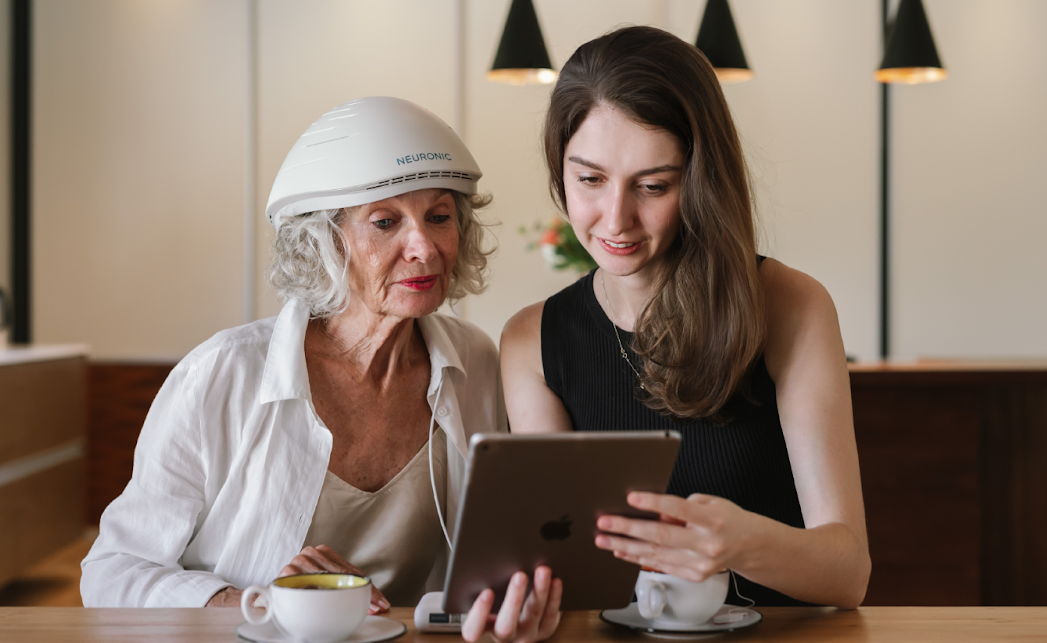
Light therapy works by stimulating the mitochondria, the tiny energy producers inside your brain cells.
Wavelengths in the near-infrared spectrum (600 – 1100 nm range) interact with the brain’s energy systems, helping neurons function more efficiently (Hamblin, 2017). When mitochondrial output declines, clarity, resilience, and focus often decline with it. Supporting cellular energy is foundational to cognitive performance at any age. Light therapy for the brain…
- Supports cellular energy production
- Improves blood flow to brain tissue
- Helps regulate inflammation
Together, these mechanisms are thought to enhance the brain’s ability to recover from stress, maintain metabolic balance, and adapt through neuroplasticity. When applying light to the brain, we call this transcranial photobiomodulation (tPBM).
Because tPBM is non-invasive and pharmaceutical-free, many families explore it as a complementary wellness tool, not a replacement for medical or psychological care.
For Parents: Sleep, Stress, and Brain Fog Reduction

If you’re a parent, you know what chronic mental fatigue feels like.
Poor sleep, constant demands, and stress can leave you feeling mentally foggy, overwhelmed, and drained. Brain fog overrides any task you attempt, and makes getting things done feel insurmountable.
In fact, the American Psychological Association found that 33% of parents rated their stress levels as “high,” compared to only 20% of the average adult population without children (2024).
Chronic stress disrupts sleep architecture, recovery cycles, and cognitive clarity. Research suggests that light therapy for the brain results in:
- Improved sleep latency and quality (Mehdizadeh, Farnam & Nikzad, 2025).
- Reduced caregiving stress (Pallanti et al., 2022)
- Improved symptoms related to brain fog, such as memory and attention (Lundie et al., 2025)
Studies suggest that PBM may support glymphatic clearance, which is closely tied to sleep quality (Valverde et al., 2023). Individuals report feeling calmer, more mentally clear, or better able to unwind when light therapy is used consistently as part of a broader wellness routine.
For Children and Teens: Focus, Attention, and ADHD Support

Many parents notice their children struggling more with focus, emotional regulation, or attention than previous generations.
Homework that should take 20 minutes stretches into an hour. Small frustrations turn into big emotional reactions. Getting out the door in the morning feels like a daily battle. Parents are left wondering what changed, and how to help.
While diagnostic rates of attention-deficit/hyperactivity disorder (ADHD) have increased significantly over the past 10 years, even attention among children without this diagnosis has decreased (Centers for Disease Control and Prevention, 2024). One survey in England showed that 69% of teachers noticed an increase in inattention and daydreaming amongst their students post-Covid (Hall, 2023).
Parents of children with ADHD or attention challenges often seek non-pharmacological strategies that support brain development without excessive stimulation.
Research on tPBM has shown support for:
- Attention and sustained focus (Chaudhari et al., 2023)
- Emotional regulation (Cassano et al., 2019)
- Working memory (Zhao et al., 2022)
Research into pediatric applications remains emergent, but early studies and clinical observations suggest that tPBM may influence neural network regulation and cortical activity patterns – processes commonly disrupted in attention-related conditions (Fradkin et al., 2024).
Pediatric use should always be guided by a qualified healthcare professional, as protocols differ from adult applications.
For Athletes: Recovery and Performance

Your brain is just as critical to athletic performance as your muscles. Elite performance is ultimately neurological before it is muscular.
Young athletes place high cognitive demands on their brains – particularly in sports requiring reaction time, decision-making, and rapid sensory processing. Many sports involve high impact too, which may result in a concussion or traumatic brain injury.
Researchers around the world are studying how light therapy may support:
- Enhancing recovery speed and symptom management after a head injury (Stevens et al., 2024).
- Improving reaction time (Lundie et al., 2025)
- Supporting attention (Lundie et al., 2025)
Studies looking at imaging of the brain and neural synchronization measures suggest that PBM may support cerebral blood flow, mitochondrial recovery, and network coherence, all of which are relevant to both performance and recovery (Nairuz, Cho & Lee, 2024).
As awareness grows that brain health is as critical as physical conditioning, many view light therapy as part of a brain-first approach to athletic development.
For Aging Adults: Supporting Memory, Cognitive Function, and Brain Resilience
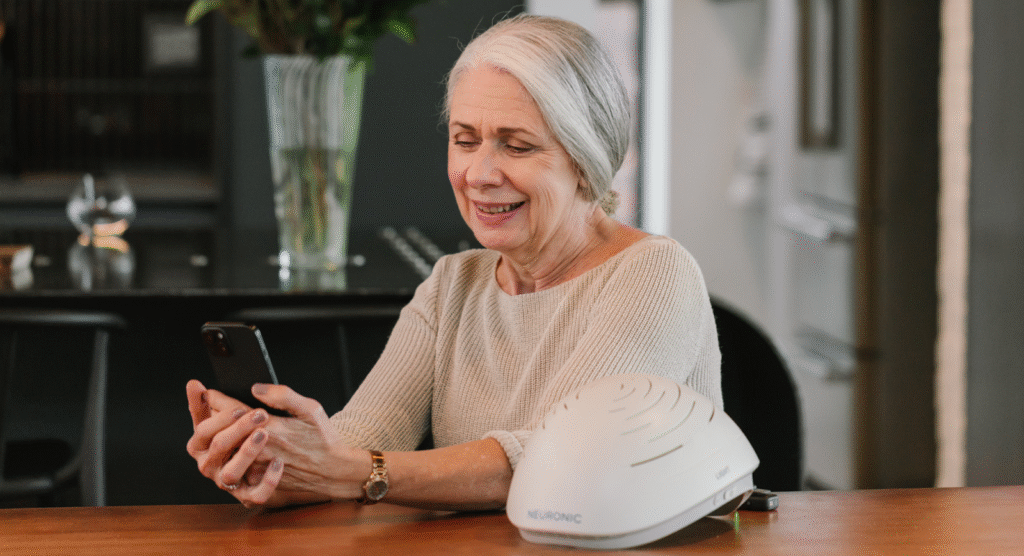
Watching a loved one struggle with memory changes can be one of the hardest parts of aging.
You see daily routines become daily challenges, and learned skills become novelties. Oftentimes caregivers and loved ones are left with more questions than answers.
As the brain ages, changes in metabolism, blood flow, and network synchronization can affect memory, movement, and emotional regulation. These changes can result in diseases such as dementia, which has affected over 55 million people as of 2020 (Alzheimer’s Disease International, n.d.).
tPBM is actively researched in older populations for:
- Cognitive decline and memory support, especially in dementia and specifically Alzheimer’s disease (Yokoi et al., 2024).
- Parkinson’s disease symptom management (Blivet et al., 2025).
- Healthy brain aging and resilience through the promotion of neurogenesis and neuroprotective factors (Qu et al., 2022).
Human pilot studies suggest that photobiomodulation may influence resting-state functional connectivity, cerebral perfusion, and neuroplastic signaling in aging brains (Rodríguez-Fernández, Zorzo & Arias, 2024). While not a cure, many families explore light therapy as a supportive or preventative strategy to help loved ones maintain independence and quality of life.
Why Many Families Are Integrating Light Therapy into Daily Life
Families are increasingly interested in light therapy because it is:
- Non-invasive and well tolerated
- Easy to integrate into daily routines
- Applicable across a wide age range
- Focused on foundational brain health rather than a single diagnosis
By supporting core processes like energy metabolism, circulation, and neural regulation, tPBM targets systems that underlie sleep, mood, focus, movement, and cognition throughout life.
In performance and longevity focused environments, tPBM is often integrated alongside sleep optimization, metabolic support, and nervous system regulation.
By supporting mitochondrial efficiency and cerebral perfusion, tPBM addresses upstream processes that influence downstream symptoms.
Is Light Therapy Right for You or Your Family?
From children learning to focus, to parents managing stress, to grandparents protecting cognitive function, brain health is a family affair.
Many families are exploring light therapy proactively, not just after problems appear.
Proactive brain support is no longer reserved for decline. It is becoming part of how families think about lifelong performance, resilience, and cognitive vitality.
If you are interested in experiencing brain photobiomodulation in a performance focused setting, you can Reserve Your Session here.
This content is for educational purposes only and is not intended to diagnose, treat, cure, or prevent any disease. Always consult a qualified healthcare professional before beginning any new therapeutic modality.
References:
Alzheimer’s Disease International. (n.d.). Dementia statistics. https://www.alzint.org/about/dementia-facts-figures/dementia-statistics/
American Psychological Association. (n.d.). Parental burnout. https://www.apa.org/topics/stress/parental-burnout
Blivet, G., et al. (2025). Brain photobiomodulation: A potential treatment in Alzheimer’s and Parkinson’s diseases. Neural Regeneration Research, 20(5), 1234–1245. https://doi.org/10.1016/j.tjpad.2025.100185
Cassano, P., Cash, S. S., Kim, M., Pattymelt, J., & Iosifescu, D. V. (2019). Selective photobiomodulation for emotion regulation: Model-based dosimetry study. Neurophotonics, 6(1), Article 015004. https://doi.org/10.1117/1.NPh.6.1.015004
Centers for Disease Control and Prevention. (n.d.). Data and statistics on ADHD. https://www.cdc.gov/adhd/data/index.html
Chaudhari, A., Liu, H., & Yan, B. (2023). Repeated transcranial photobiomodulation with light emitting diode improves cognition and neuromodulates resting-state functional connectivity in older adults. Frontiers in Neuroscience, 17, Article 1201615. https://doi.org/10.3390/bioengineering10091043
Fradkin, Y., Carlow, B., King, N., & Goligorsky, M. S. (2024). Transcranial photobiomodulation in children aged 2–6 years with autism spectrum disorder: An open-label, single-arm pilot study. Journal of Clinical and Translational Science, 8(1), Article e70. https://doi.org/10.3389/fneur.2024.1221193
Hamblin, M. R. (2018). Mechanisms and mitochondrial redox signaling in photobiomodulation. Photochemistry and Photobiology, 94(2), 199–212. https://doi.org/10.1111/php.12864
Lundie, M., Koch, M., Villanueva, A., Nguyen, T., Garner, C., Satsangi, M., Advani, P., & Krawczyk, D. (2025, October). Illuminating Cognitive Performance: Assessing the Role of Transcranial Photobiomodulation in Augmenting Cognition . Oxford Academic. https://doi.org/10.1093/milmed/usaf227
Mehdizadeh , M., Farnam , A., & Nikzad, B. (2025, October 23). Transcranial photobiomodulation improves sleep quality, reduces daytime sleepiness, and modulates delta power in chronic insomnia: A randomized controlled trial. Lasers in medical science. https://pubmed.ncbi.nlm.nih.gov/41125953/
Nairuz, T., Chen, S., & Lee, J.-H. (2024). Photobiomodulation therapy on brain: Pioneering an innovative frontier in neuroscience. Cells, 13(11), Article 928. https://doi.org/10.3390/cells13110966
Pallanti, S., Di Ponzio, M., Grassi, E., Vannini, G., & Cauli, G. (2022). Transcranial Photobiomodulation for the Treatment of Children with Autism Spectrum Disorder (ASD): A Retrospective Study. Children (Basel, Switzerland), 9(5), 755. https://doi.org/10.3390/children9050755
Stevens, A. R., et al. (2024). Photobiomodulation improves functional recovery after mild traumatic brain injury. Journal of Biophotonics. Advance online publication. https://pmc.ncbi.nlm.nih.gov/articles/PMC11883100/
Qu, X., Rhone, A., Crouthamel, B., Do, K., & Cassano, P. (2022). Repeated transcranial photobiomodulation improves working memory in older adults: A randomized, sham-controlled pilot study. Neurophotonics, 9(4), Article 046006. https://doi.org/10.1117/1.NPh.9.3.035005
Rodríguez-Fernández, L., et al. (2024). Photobiomodulation in the aging brain: A systematic review and meta-analysis of randomized clinical trials. Frontiers in Aging Neuroscience, 16, Article 1371284. https://link.springer.com/article/10.1007/s11357-024-01231-y
Valverde A;Hamilton C;Moro C;Billeres M;Magistretti P;Mitrofanis J; (2023, March 18). Lights at night: Does photobiomodulation improve sleep?. Neural regeneration research. https://pubmed.ncbi.nlm.nih.gov/36018149/
Weale, E. (2023, June 7). Children’s attention span shorter after Covid crisis, teachers say. The Guardian. https://www.theguardian.com/education/2023/jun/07/children-attention-span-shorter-covid-crisis-teachers-england-primary
Yokoi, Y., Sugiyama, H., Ihara, A., Matsuo, Y., Hashimoto, T., & Mimura, M. (2024). A randomized sham-controlled trial of transcranial and remote scalp photobiomodulation for cognitive dysfunction in patients with Alzheimer’s disease: Study protocol. Frontiers in Neurology, 15, Article 1371284. https://doi.org/10.3389/fneur.2024.1371284
Zhao, C., Li, D., Kong, Y., Liu, H., Hu, Y., Niu, H., Jensen, O., Li, X., Liu, H., & Song, Y. (2022). Transcranial photobiomodulation enhances visual working memory capacity in humans. Science Advances, 8(48). https://doi.org/10.1126/sciadv.abq3211
Leave a Reply