



Your Summer Sauna Ritual: The Hat, the Hydrogen
Summer might seem like the last time of year you’d want to sit in 175°F heat — but it’s actually one of the best windows to build a consistent sauna practice. Your body is already partially heat-adapted from the warmer weather, which means every session compounds faster. Here’s exactly how we structure the full ritual at ETERNA HAUS: what to wear on your head, what to bring in with you, what to do right after, and the one timing detail almost everyone gets wrong.
Why Summer Is Actually a Great Time to Build a Sauna Habit
It feels counterintuitive to seek out more heat when it’s already warm outside, but heat acclimation is cumulative. Research on regular sauna use shows measurable improvements in cardiovascular efficiency, including lower resting blood pressure, improved vascular function, and increased plasma volume — changes that closely mirror the adaptations seen from aerobic exercise training (Laukkanen et al., Mayo Clinic Proceedings, 2018). When your body is already working to regulate its temperature in summer heat, a sauna session builds directly on top of that adaptation instead of starting from zero.
The heat stress from a sauna session also triggers a hormetic response — a small, controlled stressor that makes your cells more resilient. This happens through activation of heat shock proteins and the Nrf2 pathway, which switches on your body’s own antioxidant and anti-inflammatory machinery (Patrick & Johnson, Experimental Gerontology, 2021). In other words, the goal of a sauna session isn’t to avoid all stress on the body — it’s to apply the right amount, so your body responds by getting stronger.
One important summer-specific note: you’re already losing fluid and electrolytes to ambient heat before you ever step into the sauna. Hydrate well before your session, and consider electrolytes rather than water alone.
Why We Never Skip the Hat
Heat rises, and inside a sauna the air temperature near your head can run noticeably hotter than at floor or bench level. Your scalp, ears, and hair are also more exposed and more sensitive to prolonged direct heat than the rest of your body, which is otherwise protected by a towel or sauna wrap. A sauna hat creates an insulating air layer that keeps your head at a more comfortable, stable temperature so you can stay in for your full session without your hair drying out, your ears overheating, or you needing to cut things short.
Why the Fiber Matters — and Why Wool Is Best
Not all sauna hats are created equal, and the material makes a real difference at sauna temperatures. Synthetic fibers can begin to soften and release chemical byproducts starting around 190°F, which is well within the range of a hot sauna session. Wool behaves completely differently: rather than melting, it chars, and it doesn’t begin to degrade until well past typical sauna temperatures. Wool fiber also naturally traps air in its structure, giving it insulating properties that studies estimate at roughly 80% better than cotton or synthetic alternatives — which is exactly the job you want a sauna hat to do.
Wool is also naturally moisture-wicking. It can absorb a significant amount of moisture from sweat while still feeling dry to the touch, and it stays breathable even when damp, so your head doesn’t overheat from trapped humidity the way it might under a synthetic cap.
This is why our ETERNA HAUS 100% Merino Wool Sauna Hat is made from merino wool specifically — soft against the skin, naturally temperature-regulating, and built for real sauna heat rather than just for looks. If you don’t already have one, it’s an easy, inexpensive addition that makes every session more comfortable and lets you stay in longer.
Bring the MOBOT In With You: Roll Out and Hydrate at the Same Time
One of our favorite sauna accessories doubles as two tools in one. The MOBOT Foam Roller Water Bottle is exactly what it sounds like — a foam roller built around an insulated water bottle — and it’s genuinely perfect for sauna use.
Heat is one of the best environments for myofascial release. Warm muscle tissue is more pliable, so rolling out tight spots while you’re already heated up in the sauna gets you a deeper release than foam rolling cold ever will. Instead of stepping out to grab water and then separately foam rolling later, the MOBOT lets you do both in the same 20–25 minutes: sip to stay ahead of the fluid you’re losing to sweat, and roll out your calves, quads, back, or feet in between sips, all without leaving your seat.
It’s a small addition, but pairing hydration and recovery work inside the heat — rather than treating them as separate steps before and after — is one of the easiest ways to get more out of every session.
After Your Session: Why We Reach for Hydrogen Inhalation
Heat stress produces reactive oxygen species (ROS) as part of the adaptive signal that trains your cells to become more resilient — that’s a feature of the hormetic response, not a flaw. The goal after a sauna session isn’t to wipe out all of that signaling with a blanket antioxidant. It’s to clear the excess oxidative byproduct without shutting down the beneficial adaptation your body just triggered.
This is where molecular hydrogen is unique. Unlike broad-spectrum antioxidants, hydrogen gas selectively neutralizes the hydroxyl radical — one of the most reactive and damaging ROS in the body — while leaving the more moderate, signaling-related ROS largely untouched (Ohsawa et al., Nature Medicine, 2007). That selectivity is what makes it such a good pairing with heat exposure: it helps manage the oxidative load from your sauna session without interfering with the very adaptation you just worked for.
A 2019 randomized, double-blind, placebo-controlled trial found that short-term hydrogen gas inhalation improved running performance and reduced markers of exercise-induced strength loss in healthy adults (Javorac et al., Biology of Sport, 2019) — supporting the same mechanism at play after a heat-stress session like sauna. At ETERNA HAUS, we recommend a session on our H2 Platinum Molecular Hydrogen Therapy immediately following your sauna to support this process.
The Binder Window — the Timing Detail Almost Everyone Misses
Binders like activated charcoal, chlorella, and zeolite work by adsorbing compounds in the digestive tract so they can be safely eliminated. The catch is that binders aren’t selective — they don’t just grab the toxins you’re targeting. Taken too close to a meal, supplement, or medication, a binder can also bind up the nutrients or active ingredients you actually want your body to absorb, significantly reducing their effectiveness (StatPearls, NCBI).
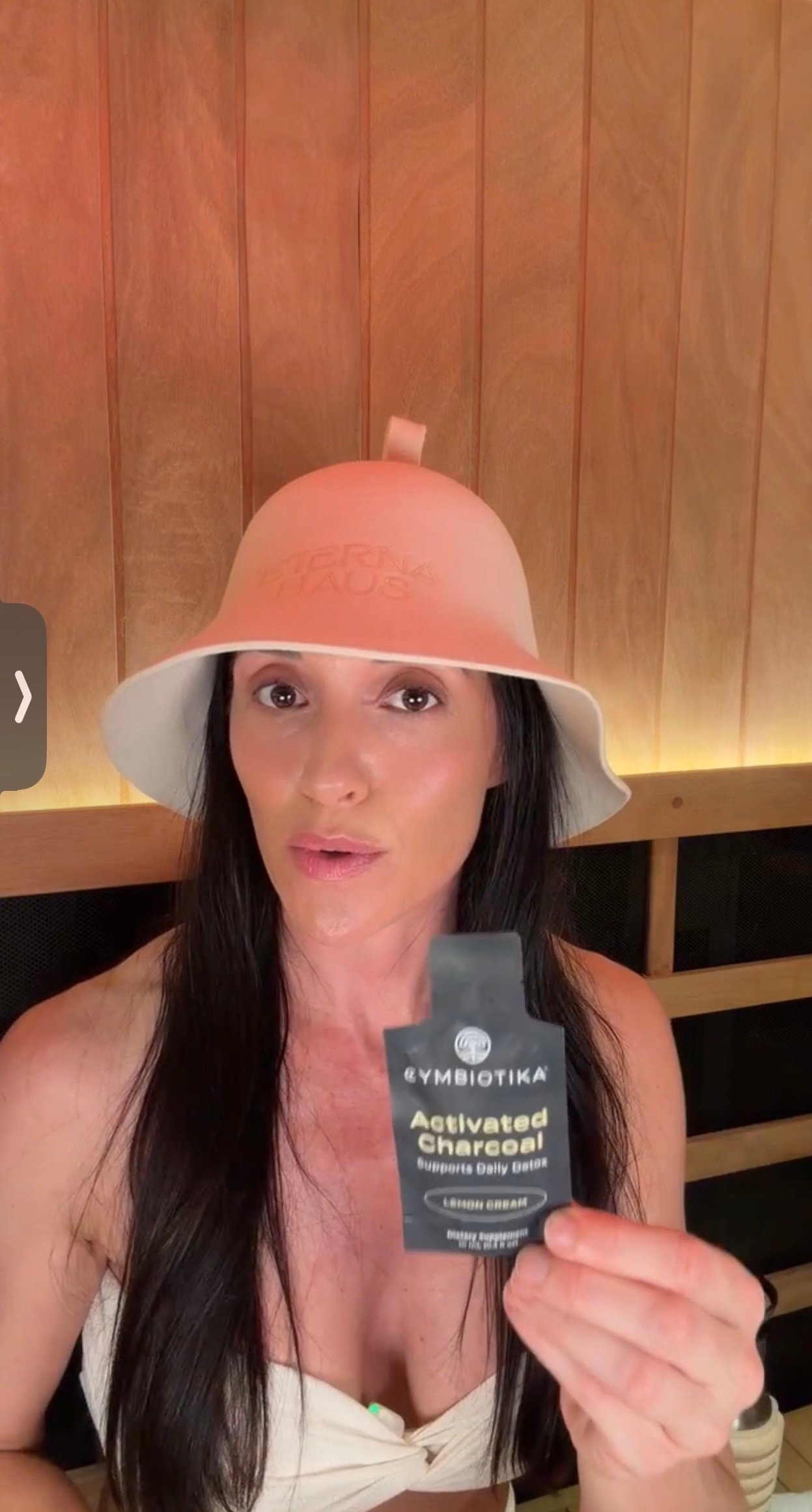
That’s why timing matters as much as the binder itself. Here’s the protocol we recommend around a sauna session:
- 2+ hours before your binder: your last meal, supplements, or medications
- 1 hour before your sauna session: take your binder on an empty stomach with water
- Sauna session: 20–25 minutes, sauna hat on, MOBOT in hand
- Immediately after: hydrogen inhalation to support oxidative stress recovery
- 2+ hours after your binder dose: wait before eating again or taking any supplements or medications
Keeping that 2+ hour buffer on both sides of your binder dose — and using the 1-hour-before window specifically for the binder itself — helps make sure it’s doing its job on what you actually want it to bind, without pulling double duty on your breakfast or your morning supplements.
Putting It All Together
A full summer sauna ritual at ETERNA HAUS looks like this: hydrate well beforehand, take your binder on an empty stomach about an hour before your session, wear your wool sauna hat throughout, roll out and sip water with your MOBOT while you sweat, and finish with a round of molecular hydrogen inhalation to support your body’s recovery from the heat stress you just intentionally applied. Each piece supports the next — and the sequencing is what makes the whole ritual work.
The Science
Laukkanen, J.A., et al. “Sauna Bathing and Systemic Inflammation.” Mayo Clinic Proceedings, 2018. View Research
Patrick, R.P. & Johnson, T.L. “Sauna use as a lifestyle practice to extend healthspan.” Experimental Gerontology, 2021. View Research
Ohsawa, I., et al. “Hydrogen acts as a therapeutic antioxidant by selectively reducing cytotoxic oxygen radicals.” Nature Medicine, 2007. View Research
Javorac, D., et al. “Short-term H2 inhalation improves running performance and torso strength in healthy adults.” Biology of Sport, 2019. View Research
“Activated Charcoal.” StatPearls, National Center for Biotechnology Information. View Research
These wellness therapies are designed to support the body’s natural recovery and restoration processes and are not intended to diagnose, treat, cure, or prevent any disease.
Leave a Reply